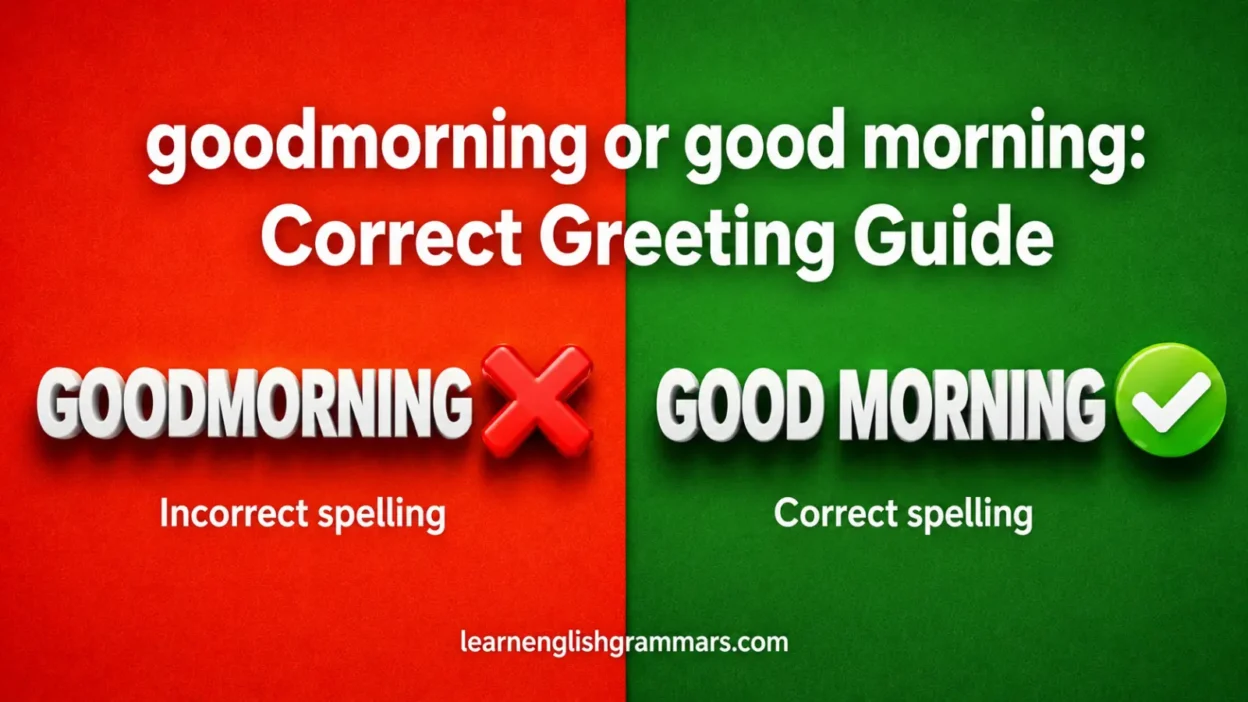
The correct choice is good morning as two words. Goodmorning is a common spelling mistake in standard US English. You may see it in fast texts, usernames, hashtags, or casual social posts, but it is not the normal written form of the greeting.
This difference matters most in emails, school writing, captions, customer messages, and professional notes. A small spacing mistake can make an otherwise polite greeting look careless. Once you know that the phrase is made from two separate words, the choice becomes simple.
Quick Answer
Use good morning when you greet someone in the morning. Do not write goodmorning as one word in standard writing. The correct form is two words because good describes morning. Write Good morning, Ava in a message, not Goodmorning, Ava.
Why People Confuse Them
People confuse goodmorning and good morning because many English greetings look short and fixed. When a phrase is used often, writers may start to treat it like one word.
Texting also adds to the confusion. People type quickly, skip spaces, or copy forms they see online. Social media usernames and hashtags may use goodmorning because spaces are not always allowed.
Another reason is the word goodnight. In some contexts, good night and goodnight both appear, but that pattern does not make goodmorning correct. The standard greeting remains good morning.
Key Differences At A Glance
| Context | Best Choice | Why |
|---|---|---|
| Email greeting | good morning | Standard and professional |
| Text message | good morning | Correct even in casual writing |
| School assignment | good morning | Accepted standard form |
| Greeting card | good morning | Natural and polished |
| Social caption | good morning | Clear and correct |
| Username or hashtag | goodmorning | Only acceptable as a style choice when spaces are not allowed |
Meaning and Usage Difference
Good morning is a greeting. It means you are saying hello politely during the morning. You can use it when you meet someone, start an email, begin a class, greet customers, or open a meeting.
Goodmorning does not have a separate standard meaning. It is usually just a misspelled version of good morning. It may appear as a brand name, display name, hashtag, song title, or creative style, but that does not make it correct in normal sentences.
| Feature | goodmorning | good morning |
| Standard spelling | No | Yes |
| Normal meaning | Misspelling of the greeting | Morning greeting |
| Best use | Usernames, hashtags, creative names only | Emails, texts, speech, school, work |
| Word form | Nonstandard closed form | Two-word phrase |
Pronunciation is simple because the spoken phrase is the same idea: good MOR-ning. The spelling problem is not about sound. It is about whether the phrase should be written as one word or two.
Tone, Context, and Formality
Good morning works in both formal and informal settings. You can use it with a teacher, boss, customer, friend, neighbor, or family member.
Examples:
Good morning, Ms. Carter.
Good morning, team.
Good morning! Hope your day starts well.
Good morning, everyone, and welcome.
Goodmorning looks informal at best and incorrect at worst. In a business email, it can make the message seem rushed. In school writing, it may be marked as a spelling error. In captions, it can still look unpolished unless it is part of a deliberate username or tag.
Capitalization depends on placement. At the start of a sentence or greeting line, write Good morning. In the middle of a sentence, lowercase is usually fine: She said good morning before leaving.
Which One Should You Use?
Use good morning almost every time. It is the safe choice for daily writing, professional messages, social captions, and classroom work.
Choose good morning when you write:
Good morning, Daniel.
Good morning, I hope you are doing well.
I sent her a good morning message.
The host began with “Good morning, everyone.”
Avoid goodmorning in normal sentences. The only time it may be acceptable is when it is part of a fixed name, handle, tag, or design where spaces are removed on purpose.
When One Choice Sounds Wrong
Goodmorning sounds wrong in standard writing because it joins two words that normally stay separate. Readers still understand what you mean, but the spelling looks off.
Incorrect: Goodmorning, class.
Correct: Good morning, class.
Incorrect: I sent a goodmorning text.
Correct: I sent a good morning text.
Incorrect: Goodmorning everyone, please take your seats.
Correct: Good morning, everyone. Please take your seats.
The correct phrase also needs punctuation when you address someone directly. Add a comma after the greeting or before the name when needed.
Correct: Good morning, Sarah.
Correct: Good morning, everyone.
Common Mistakes (and Quick Fixes)
One common mistake is writing the greeting as one word.
Wrong: Goodmorning, Mom.
Right: Good morning, Mom.
Another mistake is capitalizing both words in a normal sentence.
Less natural: I said Good Morning to the bus driver.
Better: I said good morning to the bus driver.
Writers also forget the comma after the greeting.
Wrong: Good morning team.
Right: Good morning, team.
Some people use goodmorning because they see it in hashtags. That is fine inside a tag, but not in a normal sentence.
Hashtag style: #goodmorning
Sentence style: Good morning, everyone.
Everyday Examples
Good morning, I hope your week is going well.
Good morning, Mr. Allen. I attached the report below.
She said good morning before she opened the store.
Good morning, everyone. Let’s begin with today’s schedule.
I sent him a good morning message before work.
Good morning! Your coffee is on the counter.
The receptionist greeted each guest with a warm good morning.
Good morning, team. Please review the notes before noon.
He wrote “goodmorning” in the caption, but “good morning” would look cleaner.
My grandmother sends a good morning text every Sunday.
Dictionary-Style Word Details
Verb
goodmorning: Not commonly used as a verb in standard US English.
good morning: Not commonly used as a verb. It is normally a greeting phrase, not an action word. In rare playful writing, someone might say a person “good-morninged” everyone, but that is not standard everyday usage.
Noun
goodmorning: Not a standard noun in normal US English. It may appear as a name, handle, or creative label.
good morning: Can work as a noun phrase when you talk about the greeting itself.
Example: She gave me a cheerful good morning.
Synonyms
goodmorning: No exact standard synonyms because it is not the correct form of the greeting.
good morning: Closest plain alternatives include morning, hello, hi, and have a good morning. These are not always exact replacements. Morning is more casual, while hello works at any time of day.
Clear opposites are limited because greetings do not always have true antonyms. Time-based alternatives include good afternoon, good evening, and good night, but they are not direct opposites.
Example Sentences
goodmorning: Avoid this spelling in standard sentences.
Example: “Goodmorning, friends” should be written as “Good morning, friends.”
good morning: Good morning, Maya. I hope you slept well.
Example: The teacher said good morning to the class.
Example: Good morning, and thank you for joining the call.
Word History
goodmorning: No clear standard word history applies because it is not the accepted form in normal writing.
good morning: The phrase comes from the ordinary words good and morning used together as a polite greeting. The exact development of everyday greetings is broad, so it is safest to explain the current use rather than claim a specific origin date.
Phrases Containing
goodmorning: Mostly seen in usernames, hashtags, brand-style names, or creative titles where spaces are removed.
good morning: Common phrases include good morning message, good morning text, good morning email, good morning greeting, good morning everyone, and good morning sunshine.
FAQs
Is it goodmorning or good morning?
The correct form is good morning as two words. Goodmorning is not the standard spelling in normal US English. Use good morning in emails, texts, captions, schoolwork, and professional messages.
Is goodmorning one word?
No. Goodmorning should not be written as one word in standard writing. The greeting is made of two separate words: good and morning.
Can I write Good Morning with capital letters?
Yes, but only when capitalization fits the context. At the start of a greeting, write Good morning. In a title or heading, Good Morning may be acceptable. In the middle of a sentence, use lowercase: She said good morning.
Is goodmorning okay in text messages?
It is understandable, but it is still not the best spelling. Even in casual texts, good morning looks cleaner and more correct.
Why is good morning two words?
It is two words because good describes morning. Together, they form a greeting phrase. English does not normally close this phrase into one word.
Is morning the same as good morning?
No. Morning can be a casual short greeting, while good morning sounds a little more complete and polite. For example, Morning, Jake is casual. Good morning, Jake is more polished.
Should I use a comma after good morning?
Use a comma when you address someone directly. Write Good morning, Sarah and Good morning, team. The comma helps separate the greeting from the person or group.
Is goodmorning ever correct?
It can appear in usernames, hashtags, brand names, or creative titles. However, in a normal sentence, good morning is the correct form.
Conclusion
The correct choice is good morning, not goodmorning. Use the two-word form when you greet someone in the morning, start an email, write a message, or create a polished caption.
Remember the simple rule: good and morning stay separate. Goodmorning may appear online as a style choice, but good morning is the standard form readers expect in clear US English.