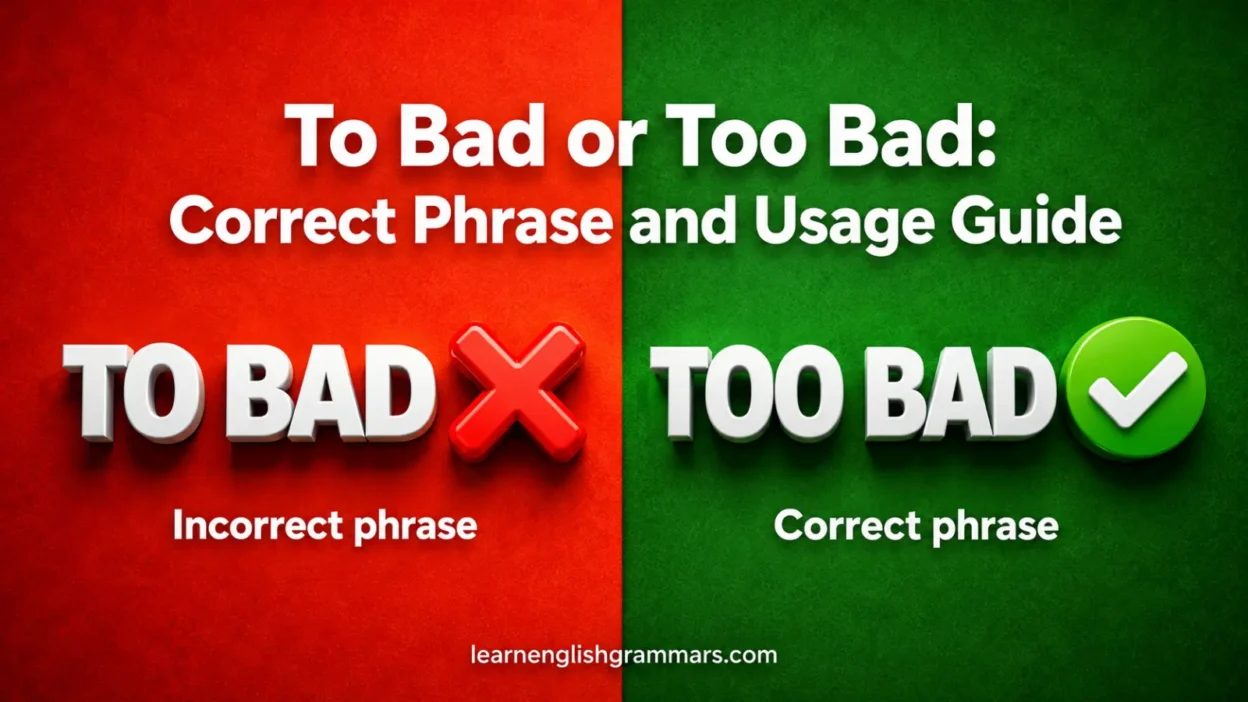
The correct phrase is usually too bad, not to bad. You write too bad when you mean something is unfortunate, disappointing, or beyond a reasonable limit.
The phrase to bad is usually a mistake when writers mean too bad. However, the word sequence can appear in a different sentence structure, such as “from good to bad.” The key is knowing whether you need too as an intensifier or to as a preposition.
Quick Answer
Use too bad when you mean “very unfortunate,” “what a shame,” or “more bad than acceptable.” Write That’s too bad, not That’s to bad. The form to bad is not the correct phrase for showing regret or disappointment, though it can appear in other grammar patterns.
Why People Confuse Them
People confuse to bad and too bad because to and too sound the same in normal speech. The difference appears in writing.
The word too often means “more than enough” or “very.” That is why it works before an adjective like bad.
The word to usually points toward direction, purpose, result, or a relationship between words. It does not intensify bad in the phrase too bad.
So the sound is similar, but the job is different.
Key Differences At A Glance
| Context | Best Choice | Why |
|---|---|---|
| Showing sympathy | too bad | It means something is unfortunate or sad. |
| Saying something is disappointing | too bad | It expresses regret or disappointment. |
| Saying something is worse than acceptable | too bad | Too can mean “excessively” before an adjective. |
| Writing “That’s ___” | too bad | “That’s too bad” is the standard phrase. |
| Showing movement or change toward bad | to bad | To can appear in a structure like “from good to bad.” |
| Casual dismissive reply | too bad | It can mean “nothing can be done” or “I do not care.” |
Meaning and Usage Difference
Too bad is the correct phrase when too modifies the adjective bad. It can mean something is unfortunate, disappointing, or more negative than desired.
Examples:
- It is too bad the concert was canceled.
- That’s too bad about your phone.
- The weather was too bad for a beach day.
In these sentences, too adds force to bad.
To bad is not the correct phrase when you mean “unfortunate” or “what a shame.” You should not write:
- That’s to bad.
- It’s to bad you missed it.
- The news is to bad.
Still, to bad can appear when to belongs to another structure. For example:
- The situation went from good to bad.
- His attitude changed from calm to bad in one day.
In those examples, to does not mean “very.” It shows movement or change toward a bad condition.
Tone, Context, and Formality
Too bad works in both casual and standard writing. You can use it in texts, emails, school writing, and everyday speech.
Its tone depends on context.
When used kindly, too bad shows sympathy:
- That’s too bad. I hope tomorrow goes better.
- It’s too bad you couldn’t come with us.
When used sharply, too bad can sound dismissive:
- Too bad. You still have to follow the rules.
- If he missed the deadline, too bad.
Because of that, be careful with tone. In a polite message, add a warmer phrase after it:
- That’s too bad. I’m sorry that happened.
- It’s too bad we missed you. Let’s plan another time.
To bad has no special tone as a phrase because it is usually not the phrase you need. It only works when to has its own grammar role.
Which One Should You Use?
Use too bad in almost every sentence where you are choosing between to bad or too bad.
Choose too bad when you mean:
- unfortunate
- disappointing
- very bad
- more bad than acceptable
- what a shame
Correct examples:
- It’s too bad that the store closed early.
- The road conditions were too bad to drive.
- That’s too bad, but we can try again next week.
Use to bad only when to is part of another structure, often after a word like from or after a phrase that leads into bad.
Correct examples:
- The review changed from good to bad.
- The mood went from fun to bad fast.
If you can replace the phrase with what a shame, use too bad.
When One Choice Sounds Wrong
To bad sounds wrong when it appears after that’s, it’s, or so and means “unfortunate.”
Wrong:
- That’s to bad.
- It’s to bad you missed dinner.
- The timing was to bad.
Correct:
- That’s too bad.
- It’s too bad you missed dinner.
- The timing was too bad.
The phrase too bad can also sound wrong if the sentence needs a preposition instead of an intensifier.
Awkward:
- The story moved from good too bad.
Correct:
- The story moved from good to bad.
Here, to is correct because the sentence shows change from one state to another.
Common Mistakes (and Quick Fixes)
Mistake 1: Writing to bad after “that’s”
- Wrong: That’s to bad.
- Correct: That’s too bad.
Mistake 2: Using to bad before a “that” clause
- Wrong: It’s to bad that you lost your keys.
- Correct: It’s too bad that you lost your keys.
Mistake 3: Forgetting that too can mean “excessively”
- Wrong: The roads were to bad to drive on.
- Correct: The roads were too bad to drive on.
Mistake 4: Using too when the sentence needs direction or change
- Wrong: The service went from helpful too bad.
- Correct: The service went from helpful to bad.
Quick fix: Ask yourself, “Do I mean very, excessively, or unfortunate?” If yes, use too bad. If the sentence means movement or change toward a bad state, use to bad.
Everyday Examples
Here are natural examples of too bad:
- It’s too bad the game was rained out.
- That’s too bad about your interview.
- The coffee tasted too bad to finish.
- The traffic was too bad for us to arrive on time.
- Too bad we didn’t buy tickets earlier.
- It’s too bad she had to cancel the trip.
- The first draft was not too bad, but it needed work.
- That movie was too bad to recommend.
- Too bad, but the sale ended yesterday.
- It’s too bad we missed the opening act.
Here are natural examples where to bad can appear:
- The situation went from good to bad quickly.
- His mood shifted from okay to bad after the call.
- The plan went from risky to bad once the budget changed.
- The review moved from mixed to bad after the final section.
The first group uses too to describe degree or regret. The second group uses to to show change.
Dictionary-Style Word Details
Verb
- to bad: Not commonly used as a verb phrase in standard US English. To may appear before a verb, but bad is not normally used as a verb in this comparison.
- too bad: Not used as a verb. It is a phrase built with too plus the adjective bad.
Noun
- to bad: Not used as a noun phrase in this comparison. In a sentence like “from good to bad,” bad can name a condition or category, but to bad itself is not a standard noun.
- too bad: Not normally used as a noun. It works as an adjective phrase or idiomatic expression.
Synonyms
- to bad: No true synonyms as a phrase because it is not the standard expression for regret or disappointment.
- too bad: Closest plain alternatives include unfortunate, a shame, sad, disappointing, and regrettable.
Helpful replacements:
- “That’s too bad” = “That’s a shame.”
- “It’s too bad” = “It’s unfortunate.”
- “The weather was too bad” = “The weather was too severe.”
Clear opposites depend on meaning. For sympathy, a loose opposite may be that’s great. For degree, an opposite may be not bad or good enough.
Example Sentences
- to bad: The project went from promising to bad after several errors.
- to bad: The mood shifted from cheerful to bad near the end of the meeting.
- too bad: That’s too bad. I know you were excited about the trip.
- too bad: The food was too bad to serve.
- too bad: It’s too bad that nobody saved a copy.
- too bad: The damage was too bad for a quick repair.
Word History
- to bad: There is no special phrase history for to bad as a standard expression. It is usually just to followed by bad in a larger sentence structure.
- too bad: The phrase comes from the normal use of too before an adjective. In modern English, it also works as a common idiom for sympathy, regret, or dismissal.
No exact first-use claim is needed here. For everyday writers, the important point is current standard usage.
Phrases Containing
- to bad:
- from good to bad
- go from okay to bad
- change from decent to bad
- too bad:
- that’s too bad
- it’s too bad
- too bad to fix
- too bad to ignore
- too bad for you
- too bad so sad
Use the too bad phrases carefully. Some can sound kind, while others can sound rude or dismissive.
FAQs
Is it “to bad” or “too bad”?
The correct phrase is too bad when you mean something is unfortunate, disappointing, or very bad. Write That’s too bad, not That’s to bad.
Is “to bad” ever correct?
Yes, but only in a different sentence structure. For example, “The situation went from good to bad” is correct because to shows change. It is not the same as the phrase too bad.
Why is “too bad” correct?
Too can modify an adjective. Since bad is an adjective, too bad can mean “excessively bad,” “very unfortunate,” or “what a shame.”
Can “too bad” sound rude?
Yes. Too bad can sound rude if it means “I do not care” or “nothing can be done.” To sound kinder, add context: “That’s too bad. I’m sorry that happened.”
What is the difference between “to” and “too”?
To is usually a preposition or part of an infinitive. Too is an adverb that can mean “also,” “very,” or “more than enough.” In too bad, you need the adverb too.
Which sentence is correct: “It’s to bad” or “It’s too bad”?
The correct sentence is “It’s too bad.” Use it when something is unfortunate or disappointing.
Can I use “too bad” in formal writing?
Yes, but choose the tone carefully. In formal writing, unfortunate or regrettable may sound more polished. In everyday writing, too bad is natural and clear.
What is a simple trick to remember the correct spelling?
Use too with the extra o when you mean “extra” or “very.” Since too bad means bad to an extra degree, the version with two o’s is usually correct.
Conclusion
The correct choice is usually too bad. Use it when you mean something is unfortunate, disappointing, or more bad than acceptable. It is the right form in sentences like “That’s too bad” and “It’s too bad you missed it.”
Use to bad only when to belongs to another structure, such as “from good to bad.” If you mean “what a shame,” choose too bad every time.