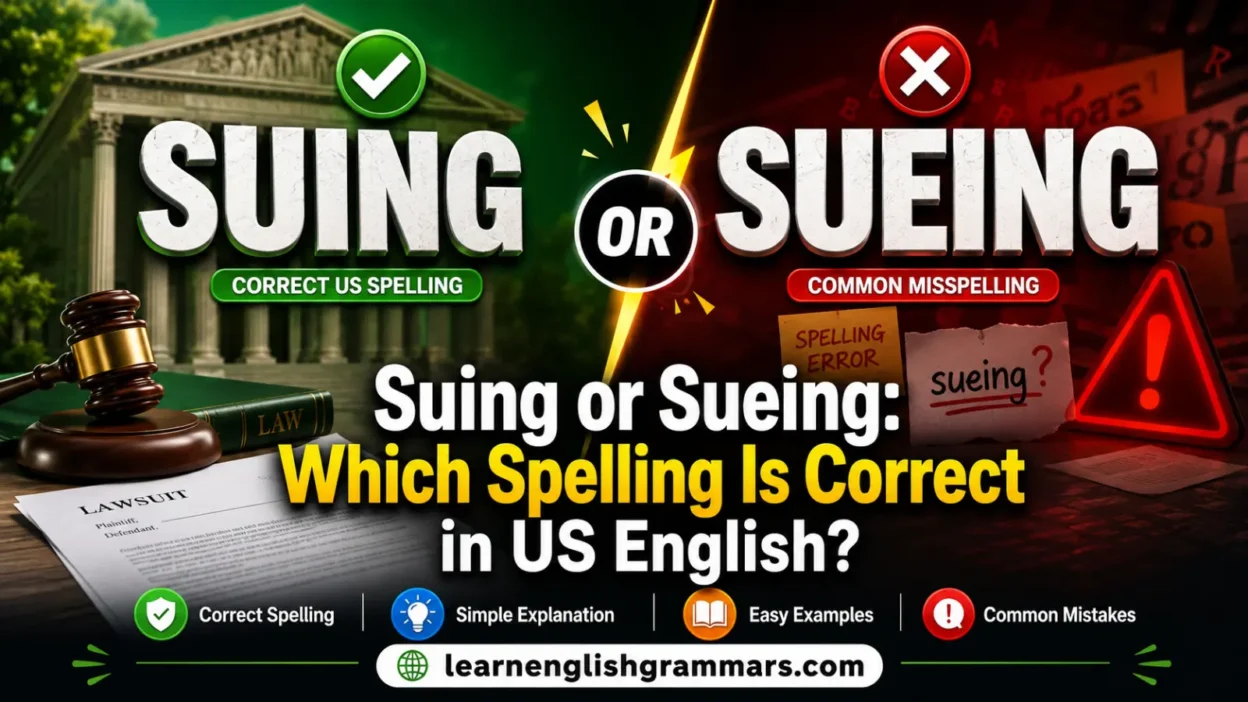
Choosing between suing and sueing may feel harder than expected. The base verb is sue, so keeping the final e can appear logical when adding -ing.
However, standard American English uses only suing as the present participle and gerund of sue. Sueing is a nonstandard spelling in ordinary writing. The two forms do not have different legal meanings, tones, or grammatical jobs.
Quick Answer
Suing is the correct spelling. Sueing is nonstandard.
Use suing when someone is taking legal action or considering a lawsuit:
- The customer is suing the company.
- They are thinking about suing their landlord.
The verb sue drops its final e before -ing is added: sue → suing.
Why People Confuse Them
The confusion begins with the base form sue. Writers often assume that adding -ing means placing the ending directly after the complete word:
- sue + ing = sueing
That construction looks reasonable, but it does not produce the standard form. In this word, the final e is removed first:
- sue − e + ing = suing
The spelling can also look unusual because suing contains three vowels in a row. Even so, it is pronounced naturally as two syllables: SOO-ing.
English does not apply one final-e pattern without exceptions. Therefore, it is better to remember the specific form sue → suing rather than treating the rule as universal.
Key Differences At A Glance
| Context | Best Choice | Why |
|---|---|---|
| An action happening now | suing | It is the standard present participle |
| An activity discussed generally | suing | It can function as a gerund |
| Legal or business writing | suing | It is the recognized spelling |
| Informal messages | suing | The standard spelling does not change by tone |
| Correcting a misspelling | Change sueing to suing | Sueing is not the standard verb form |
Compact comparison:
- Suing: Standard spelling; means taking or pursuing legal action.
- Sueing: Nonstandard spelling; does not have a separate meaning.
- Pronunciation: Suing is pronounced SOO-ing, with two syllables.
Meaning and Usage Difference
Suing is formed from the verb sue. In its most common modern meaning, it refers to bringing or pursuing a legal action against a person, company, organization, or other party.
As a present participle, suing appears with a helping verb:
- The former employee is suing the business.
- Several residents are suing the property owner.
It can also function as a gerund. In that role, it names the activity:
- Suing can require time and money.
- She discussed suing after the contract dispute.
Sueing does not express a different action. It is simply a nonstandard way of spelling the same intended form. Changing the spelling does not change the tense, meaning, or legal situation.
The verb may be used in several common structures:
- sue someone: They plan to sue the contractor.
- sue for something: She is suing for damages.
- sue over something: The tenants are suing over unsafe conditions.
Tone, Context, and Formality
Suing is appropriate in formal, neutral, and informal English. Its spelling remains the same in court documents, news reports, business emails, school assignments, and everyday conversations.
The word itself often sounds serious because it describes legal action. That seriousness comes from its meaning, not from a special level of formality in the spelling.
Sueing does not create a more casual or more traditional tone. In most contexts, readers will treat it as a spelling mistake. It can be especially distracting in legal, academic, workplace, or published writing.
Pronunciation does not create a contrast between the two forms. The intended word is pronounced SOO-ing, regardless of how someone mistakenly writes it.
Which One Should You Use?
Use suing every time you need the -ing form of sue.
Choose it when describing:
- legal action happening now
- plans to begin legal action
- the general act of bringing a lawsuit
- a person or group pursuing a claim
- a discussion about whether legal action is worthwhile
Examples include:
- Our neighbor is suing the builder.
- The company considered suing for breach of contract.
- Suing was their final option.
Do not use sueing as an alternative spelling. American and British spelling preferences do not create a valid contrast here. The standard form is suing.
When One Choice Sounds Wrong
Sueing sounds wrong in any sentence where it is intended as the present participle or gerund of sue.
Incorrect:
- She is sueing her former employer.
- They discussed sueing the manufacturer.
- The customer may be sueing for damages.
Correct:
- She is suing her former employer.
- They discussed suing the manufacturer.
- The customer may be suing for damages.
The error becomes more noticeable in formal writing because readers expect careful spelling. Still, the same correction applies in a text message or casual post.
Suing would sound wrong only when the sentence requires another verb form. For example, an action completed yesterday requires sued, not suing.
Common Mistakes (and Quick Fixes)
Mistake 1: Keeping the final e
Incorrect: The tenant is sueing the owner.
Correct: The tenant is suing the owner.
Quick fix: Remove the final e before adding -ing.
Mistake 2: Treating both forms as acceptable options
Incorrect idea: Suing is American, while sueing is British.
Quick fix: Use suing in standard English regardless of the regional style.
Mistake 3: Using the wrong sentence pattern
Awkward: The customer is suing against the store.
Natural: The customer is suing the store.
Quick fix: Place the person or organization directly after sue when naming the party facing the legal action.
Mistake 4: Confusing the action with the completed past
Incorrect: She is sued the company.
Correct: She is suing the company.
Quick fix: Use is suing for an action in progress and sued for a completed past action.
Mistake 5: Assuming pronunciation follows the compact spelling
Suing is not pronounced like swing. Say it as two syllables: SOO-ing.
Everyday Examples
- The homeowners are suing the developer over construction problems.
- He spoke with an attorney before suing his former business partner.
- The passenger considered suing after the accident.
- A local business is suing for breach of contract.
- The family decided that suing was not their best option.
- Several customers are suing the manufacturer.
- She denied that she was planning on suing anyone.
- Before suing, they tried to resolve the dispute directly.
- The landlord was surprised to learn that the tenant was suing.
- Their attorney explained the possible cost of suing the company.
Dictionary-Style Word Details
Verb
- Suing: The standard present participle of sue. It is used in progressive verb forms such as is suing, was suing, and will be suing.
- Sueing: Not the standard present-participle spelling. Replace it with suing when referring to legal action or another recognized sense of sue.
Noun
- Suing: Can function as a gerund, which is a verb form used like a noun. Example: “Suing may not resolve the dispute quickly.”
- Sueing: Not normally used as a standard gerund spelling. The correct form is suing.
Synonyms
- Suing: Closest plain alternatives include taking legal action, bringing a lawsuit, filing suit, and pursuing a legal claim. These alternatives may differ slightly depending on whether a case has actually been filed.
- Sueing: Has no separate synonyms because it is not a distinct standard word. The correct replacement is suing.
A clear direct antonym does not apply in every situation. Defending a lawsuit describes the other side’s action, but it is not an exact opposite of suing.
Example Sentences
- Suing: The customer is suing the repair company for property damage.
- Suing: They are considering suing over the canceled agreement.
- Suing: Suing should not be treated as the only way to settle every disagreement.
- Sueing: “The customer is sueing the company” should be corrected to “The customer is suing the company.”
- Sueing: “They discussed sueing” should be written as “They discussed suing.”
Word History
- Suing: Comes from the verb sue, which entered English through French and traces back to a Latin root connected with following or pursuing. The standard inflected form developed as suing.
- Sueing: Does not have a separate standard history or meaning. It generally arises when a writer keeps the final e while adding -ing.
Phrases Containing
- Suing: suing for damages, suing for compensation, suing over a contract, suing a company, considering suing, and planning on suing.
- Sueing: No standard phrases require this spelling. In any intended verb or gerund phrase, use suing instead.
FAQs
Is suing or sueing the correct spelling?
Suing is the correct spelling in standard American English. It is the present participle and gerund form of the verb sue. Sueing is generally treated as a spelling mistake. Use suing in casual, professional, academic, and legal writing.
Why does sue become suing?
The final e in sue is removed before the ending -ing is added. The correct formation is sue → suing. Although the result contains three vowels in a row, suing is still the accepted spelling.
Is sueing accepted in British English?
No. Sueing is not a standard British spelling of the word. Both American and British English normally use suing. This comparison is not like color and colour, where regional spelling preferences create two accepted forms.
How do you pronounce suing?
Suing is pronounced SOO-ing. It has two syllables. It should not be pronounced like swing. Saying the word slowly as “sue-ing” can help you remember both its pronunciation and correct spelling.
Can suing be used as a noun?
Suing can function as a gerund, which is a verb form used like a noun. For example, “Suing may be expensive” uses suing as the subject of the sentence. However, it still comes from the verb sue.
What are some examples of suing in a sentence?
Here are several natural examples:
- The customer is suing the company for damages.
- They considered suing their landlord.
- She spoke with an attorney before suing.
- The business is suing over a broken contract.
- Suing was their final option.
In each example, suing is correct. Replacing it with sueing would create a spelling error.
Conclusion
The correct choice is suing, not sueing. Suing is the standard present participle and gerund of sue. It can describe legal action in progress or name the general activity of pursuing a legal claim.
Remember the formation sue → suing. Remove the final e, add -ing, and pronounce the result SOO-ing. Use the same spelling in casual, professional, academic, and legal contexts.