The choice between nosy and nosey is easy to overthink because both spellings appear in real English. You may see one in a dictionary, another in a comment online, and both in casual writing.
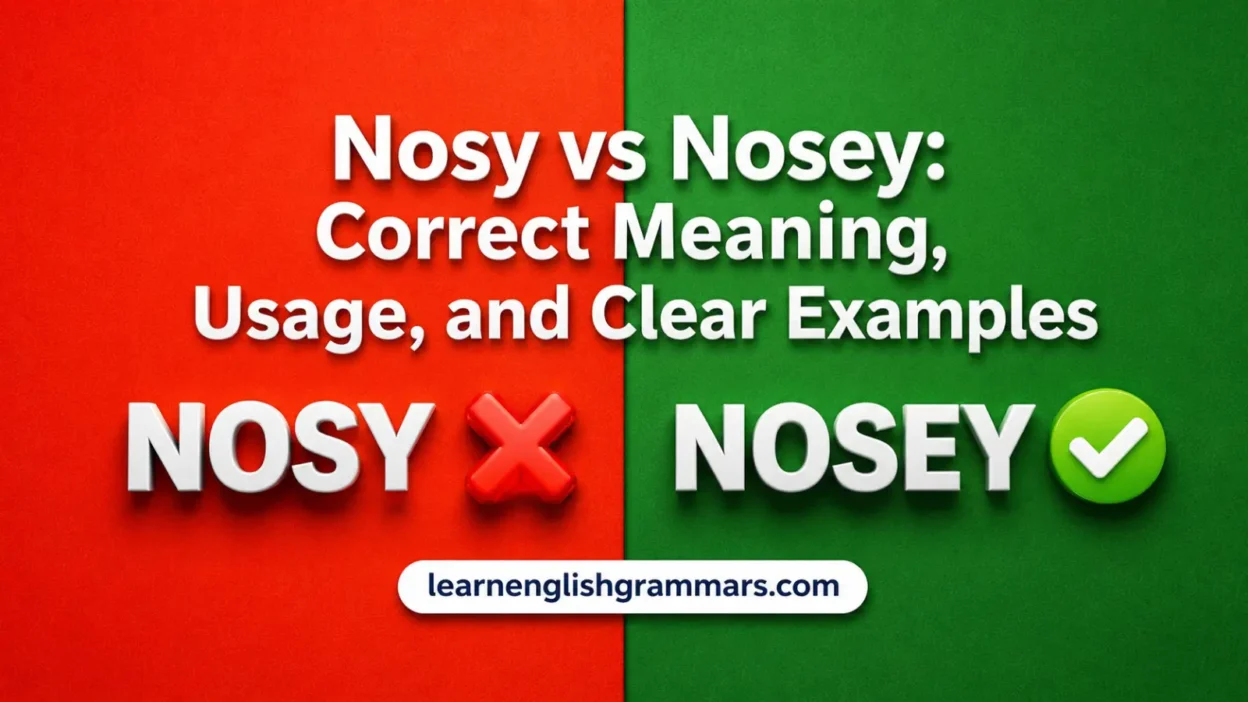
The clearest answer is simple: nosy is the better choice for modern US writing. Nosey is a recognized variant, but it is less common and can look less polished. The two words have the same meaning, the same pronunciation, and the same basic grammar role.
Quick Answer
Use nosy in most situations, especially in US English. It is the preferred spelling for describing someone who asks too many personal questions or gets too involved in other people’s private business. Nosey means the same thing, but it is a less common variant. It is not usually wrong, but nosy is safer.
Why People Confuse Them
People confuse nosy and nosey because the word comes from nose, so the spelling nosey feels logical at first. Many English adjectives keep or change letters in ways that do not always feel obvious.
However, English often drops the final e before adding y. That pattern helps explain why nose becomes nosy, much like rose becomes rosy.
Another reason is sound. Nosy and nosey are pronounced the same: NOH-zee. Since there is no pronunciation difference, people often spell the word the way it looks most natural to them.
Key Differences At A Glance
| Context | Best Choice | Why |
|---|---|---|
| School writing | nosy | It is the standard-looking form. |
| Work emails | nosy | It looks cleaner and more expected. |
| Casual texts | nosy | It is still the safer everyday spelling. |
| Dialogue in fiction | nosy or nosey | Either can work, depending on character voice. |
| Describing a person | nosy | It is the preferred spelling. |
| Describing questions | nosy | “Nosy questions” is the common form. |
| Older or informal style | nosey | It may appear as a variant. |
| Unsure which to choose | nosy | It avoids distracting the reader. |
The real difference is not meaning. It is spelling preference. Nosy is the main spelling. Nosey is a variant spelling.
Compact comparison:
- Nosy: preferred modern spelling; adjective; informal; mildly negative.
- Nosey: variant spelling; same meaning; less common; sometimes looks more casual.
- Both: describe someone overly interested in private matters.
- Neither: should be used for healthy curiosity in a positive sense.
Meaning and Usage Difference
Nosy means too interested in things that do not concern you, especially someone else’s private life. A nosy person may ask personal questions, listen in on conversations, or keep trying to learn details that were not offered.
Examples:
“She has a nosy neighbor who watches every delivery.”
“That was a nosy question to ask on a first meeting.”
“Please stop being nosy about my paycheck.”
Nosey means the same thing. The difference is that it is a less common spelling. You may still see it in casual writing, character dialogue, or older-looking style.
Examples:
“He was being nosey about the guest list.”
“My aunt gets a little nosey at family dinners.”
“Those nosey questions made everyone uncomfortable.”
In clean US writing, choose nosy unless you have a clear reason to use the variant.
Tone, Context, and Formality
Both words are informal and usually disapproving. Calling someone nosy suggests that their curiosity crosses a line. It is not as harsh as calling someone invasive or predatory, but it still carries criticism.
The word can also sound playful in the right context.
“Don’t be nosy—I’m wrapping your birthday gift.”
Here, the tone is light. The person is curious, but the sentence does not feel serious.
In a workplace, the same word can feel sharper.
“His nosy questions about salaries made the team uncomfortable.”
That sentence suggests poor boundaries. Because of that tone, use the word carefully when writing about real people.
Nosey has the same tone, but the spelling may feel more casual. In formal or professional writing, nosy is the better fit.
Which One Should You Use?
Use nosy almost every time.
It is the better choice for articles, emails, school assignments, captions, reports, and everyday US writing. Readers recognize it quickly, and it does not call attention to itself.
Use nosey only when you want the variant spelling for voice, style, or a quoted phrase. For example, a fictional character might write “nosey” in a text message, or a casual post might use it without causing confusion.
For most readers, this rule works well:
Choose nosy when you want the spelling that looks standard. Accept nosey when you see it, but do not prefer it in polished writing.
When One Choice Sounds Wrong
Nosey can look wrong in polished US writing even though it is a real variant. The issue is not meaning. The issue is reader expectation.
Less polished:
“The report warned about nosey data requests from outside vendors.”
Better:
“The report warned about nosy data requests from outside vendors.”
The second sentence looks cleaner because nosy is the expected spelling.
Still, nosy can also sound wrong when the meaning is too strong for the situation. If someone is simply interested, curious, or attentive, nosy may be unfair.
Too negative:
“She asked how my day went, so she is nosy.”
Better:
“She asked how my day went, so she seems thoughtful.”
Use nosy only when curiosity becomes intrusive.
Common Mistakes (and Quick Fixes)
Mistake 1: Treating nosey as the better spelling because it keeps nose.
Weak: “My nosey coworker keeps asking about my weekend plans.”
Better: “My nosy coworker keeps asking about my weekend plans.”
Mistake 2: Using nosy for normal curiosity.
Weak: “The student was nosy about how the experiment worked.”
Better: “The student was curious about how the experiment worked.”
Mistake 3: Using the word in a serious privacy context when a stronger word fits better.
Weak: “The hacker was nosy.”
Better: “The hacker was intrusive.”
Mistake 4: Spelling the comparative as more nosy when a smoother form fits.
Acceptable: “That question was more nosy than helpful.”
Often smoother: “That question was nosier than helpful.”
Mistake 5: Mixing both spellings in the same piece.
Weak: “The nosy neighbor asked nosey questions.”
Better: “The nosy neighbor asked nosy questions.”
Pick one spelling. For US writing, make it nosy.
Everyday Examples
“Stop being nosy and let me finish the surprise.”
“Our landlord is friendly, but he can be nosy.”
“That was a nosy thing to ask during lunch.”
“I ignored the nosy comments about my relationship.”
“She closed the door because her brother was getting nosy.”
“My nosy neighbor asked why I came home late.”
“The interviewer’s questions felt too nosy.”
“He is not mean, just a little nosy.”
“Those nosy messages made her uncomfortable.”
“Try not to sound nosy when you ask about the delay.”
“You can be supportive without being nosy.”
“My cousin is sweet, but she gets nosey at weddings.”
“That nosey look told me she wanted details.”
“I used to be nosey as a kid, but I learned to respect privacy.”
“The joke works because the character is obviously nosey.”
In most of these examples, nosy is the better spelling. The nosey examples still make sense, but they feel more casual.
Dictionary-Style Word Details
Verb
Nosy: Not commonly used as a verb in standard US English. Use pry, snoop, meddle, or nose around instead.
Example: “Don’t snoop through her messages.”
Nosey: Not commonly used as a verb in standard US English. It is mainly an adjective variant of nosy.
Example: “He kept nosing around the garage.”
This uses nose as part of a verb phrase, not nosey as a verb.
Noun
Nosy: Not commonly used as a noun by itself in standard US English. The noun form is usually nosiness for the quality, or nosy person for the person.
Example: “Her nosiness made the meeting awkward.”
Nosey: Not commonly used as a noun by itself in standard US English. You may see it as a nickname or label in casual speech, but that is not the main standard use.
Example: “Hey, nosey, stop reading over my shoulder.”
This is casual address, not the main noun form.
Synonyms
Nosy: closest plain alternatives include prying, intrusive, meddlesome, snooping, overly curious, and interfering.
Nosey: the same alternatives apply because the meaning is the same.
Useful antonyms depend on context. Good opposites include respectful, discreet, private, and unobtrusive.
Be careful with curious. It can be close, but it is often neutral or positive. Nosy means curiosity has gone too far.
Example Sentences
Nosy: “The nosy neighbor asked why we were moving.”
Nosy: “I did not answer his nosy question about my savings.”
Nosy: “The kids got nosy when they saw the wrapped gifts.”
Nosey: “A nosey guest peeked into the kitchen.”
Nosey: “She laughed and told him not to be so nosey.”
Nosey: “The character is funny because he is loud, nosey, and always wrong.”
Word History
Nosy: The word is connected to nose, with the idea of sticking one’s nose into someone else’s business. Current standard use treats nosy as the main spelling.
Nosey: This spelling keeps the e from nose, which is why it looks natural to many people. Still, it is generally treated as a variant spelling rather than the preferred form.
The safest history note is this: both spellings exist, but modern US writing strongly favors nosy as the standard-looking choice.
Phrases Containing
Nosy:
- nosy neighbor
- nosy coworker
- nosy question
- nosy reporter
- nosy relative
- nosy parker
Nosey:
- nosey neighbor
- nosey question
- Nosey Parker
The phrase nosy parker means a person who is too interested in other people’s private affairs. It is more common in British-style informal use, but US readers can still understand it.
FAQs
Is nosy or nosey correct?
Both nosy and nosey are correct spellings, but nosy is the better choice in modern US English. It is the more common and more standard-looking spelling. Nosey means the same thing, but it is usually treated as a less common variant.
What does nosy mean?
Nosy means too interested in someone else’s private life or personal business. A nosy person may ask questions that feel too personal, listen to private conversations, or try to learn details that were not shared with them.
Is nosey a real word?
Yes, nosey is a real word. It is an accepted variant spelling of nosy. However, many readers expect to see nosy, especially in polished writing, school work, articles, and professional communication.
Which spelling should I use in US English?
Use nosy in US English. It looks cleaner, more familiar, and more natural to most readers. If you are writing an email, essay, article, caption, or message for a broad audience, nosy is the safest spelling.
Do nosy and nosey have different meanings?
No, nosy and nosey do not have different meanings. Both describe someone who is overly curious about private matters. The difference is mainly spelling preference, not definition, grammar, or pronunciation.
Is nosy always rude?
Nosy usually has a negative tone, but it is not always harsh. In a serious sentence, it can sound critical. In a playful sentence, it can sound light or teasing. For example, “Don’t be nosy—I’m planning your surprise” sounds friendly, while “His nosy questions made everyone uncomfortable” sounds more serious.
Conclusion
The difference between nosy and nosey is mostly spelling preference, not meaning. Both describe someone who is too interested in private matters, and both are pronounced the same way.
For modern US writing, choose nosy. It is the clearer, cleaner, and more expected spelling. Nosey is a real variant, but it looks more casual and less standard. When in doubt, write nosy.