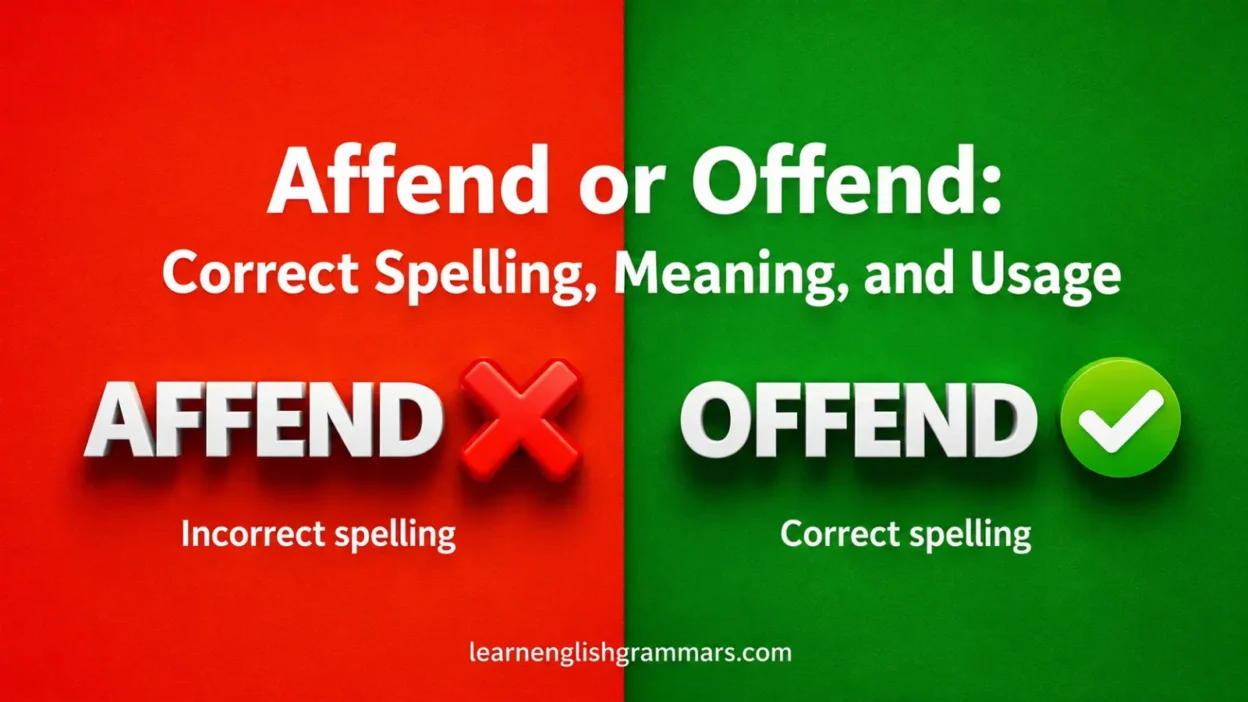
If you are choosing between affend or offend, the correct word is offend. The spelling affend is not standard English and should be avoided in schoolwork, emails, articles, messages, and professional writing.
This comparison is simple, but it still causes confusion because offend begins with a weak “uh” sound. When people hear the word quickly, they may guess that it starts with a instead of o. However, only offend has a recognized meaning and regular verb forms.
Quick Answer
Use offend, not affend. Offend means to upset, insult, hurt, annoy, or violate a rule, law, or standard. Affend is a misspelling, so it does not work as a correct word in standard US English. Write offend, offends, offended, or offending.
Why People Confuse Them
People confuse affend and offend mostly because of sound. In spoken English, the first syllable of offend sounds like uh, not a strong “oh.” That soft sound can make the first letter feel unclear.
The mistake also happens because English has many words that begin with a, such as affect, afford, and attach. A writer may see that pattern and assume affend looks possible.
Even so, the correct form is always offend when you mean to hurt feelings, upset someone, or break a rule.
Key Differences At A Glance
| Context | Best Choice | Why |
|---|---|---|
| “I didn’t mean to ___ you.” | offend | It means to upset or hurt someone. |
| “She felt ___ by the joke.” | offended | This is the correct past participle and adjective form. |
| “That smell may ___ customers.” | offend | It can mean to be unpleasant to the senses. |
| “He may ___ again.” | offend | It can mean commit another offense. |
| “I don’t want to ___ anyone.” | offend | This is the standard verb. |
| “Affend” in an email | avoid | It is not standard English. |
| Formal writing | offend | It is the only accepted choice. |
| Casual texting | offend | Casual style does not make affend correct. |
Meaning and Usage Difference
Offend is a verb. It means to make someone feel hurt, insulted, angry, annoyed, or disrespected. It can also mean to violate a law, rule, moral standard, or sense of what is proper.
Examples:
“I didn’t mean to offend you.”
“His comment offended several coworkers.”
“The loud ad offended some viewers.”
In legal or formal contexts, offend can mean to commit an offense or violate a rule.
Example:
“After his release, he promised not to offend again.”
Affend does not have a standard meaning in US English. It is usually just a mistaken spelling of offend.
The pronunciation of offend is uh-FEND. That pronunciation helps explain the spelling mistake, but it does not change the correct spelling.
Tone, Context, and Formality
Offend works in both formal and informal writing. You can use it in a friendly text, a workplace email, a school paper, a news article, or a policy note.
Examples:
“Sorry, I didn’t mean to offend you.”
“We revised the message so it would not offend customers.”
“The post offended many readers.”
Affend does not become acceptable because the tone is casual. A text message may be informal, but the correct spelling is still offend.
Compact comparison:
• Affend: not standard, not recommended, usually a typo.
• Offend: standard verb, correct in casual and formal writing.
• Best rule: when the meaning is “upset,” “insult,” or “hurt,” write offend.
Which One Should You Use?
Use offend every time.
Choose offend when you mean:
• hurt someone’s feelings
• insult someone
• upset or anger someone
• bother someone’s sense of taste, smell, sight, or decency
• violate a rule, law, or moral standard
Correct:
“I hope this question does not offend you.”
Incorrect:
“I hope this question does not affend you.”
The safest habit is to remember the spelling family: offend, offended, offending, offensive, offense. They all begin with of- or off-, not af-.
When One Choice Sounds Wrong
Affend sounds wrong because readers expect the standard spelling offend. In polished writing, affend can look like a careless typo.
Wrong:
“Please tell me if my comment affends you.”
Better:
“Please tell me if my comment offends you.”
The same problem appears with affended.
Wrong:
“She was affended by the remark.”
Better:
“She was offended by the remark.”
Also avoid using affend as if it had a special softer meaning. It does not mean “accidentally offend.” If the action was unintentional, still use offend.
Correct:
“I accidentally offended him.”
Common Mistakes (and Quick Fixes)
Mistake: “I did not mean to affend anyone.”
Fix: “I did not mean to offend anyone.”
Mistake: “She looked affended.”
Fix: “She looked offended.”
Mistake: “That joke was affending people.”
Fix: “That joke was offending people.”
Mistake: “Can this policy affend customers?”
Fix: “Can this policy offend customers?”
Another common issue is choosing offend when insult would be sharper. Offend can be intentional or accidental. Insult usually feels more direct and deliberate.
Clear:
“I didn’t mean to offend you.”
Stronger:
“He insulted her during the meeting.”
Everyday Examples
“I hope my question does not offend you.”
“That joke might offend some people.”
“She was offended by the rude email.”
“The smell from the trash offended everyone in the hallway.”
“His behavior offended the guests.”
“The company apologized to anyone it may have offended.”
“Try not to offend the client during the call.”
“That comment offended my parents.”
“The movie offended some viewers but entertained others.”
“He did not intend to offend anyone.”
“The coach was offended by the accusation.”
“The sign was removed because it offended customers.”
Dictionary-Style Word Details
Verb
Affend: Not used as a standard verb in US English. Use offend instead.
Offend: A standard verb meaning to upset, insult, hurt, annoy, displease, or violate a law, rule, or standard.
Forms:
• offend
• offends
• offended
• offending
Examples:
“She did not want to offend her host.”
“His post offended many readers.”
Noun
Affend: Not used as a standard noun.
Offend: Not commonly used as a noun. The related noun is offense in US English.
Example:
“His rude comment caused offense.”
In this article, the choice is still affend or offend, so the correct verb is offend.
Synonyms
Affend: No true synonyms, because it is not a standard word.
Offend: Closest plain alternatives include upset, hurt, insult, anger, annoy, displease, and affront.
These words are not always exact matches. Offend can be mild or serious. Insult sounds more direct. Outrage sounds much stronger.
Useful opposites include please, respect, comfort, and reassure, depending on the sentence.
Example Sentences
Affend: Not correct in standard sentences.
Incorrect: “I did not want to affend you.”
Correct: “I did not want to offend you.”
Offend: Correct standard form.
“His words offended the audience.”
“The article may offend some readers.”
“She was offended by his tone.”
“The smell offended my nose.”
“He promised not to offend again.”
Word History
Affend: No clear standard word history applies to modern US English because it is not the accepted form in this comparison.
Offend: The word comes through older forms connected with the idea of striking against, displeasing, violating, or committing a fault. Modern English keeps those ideas in two main uses: hurting someone’s feelings and breaking a rule or standard.
Do not treat affend as an older or more formal spelling of offend. For current US writing, offend is the correct form.
Phrases Containing
Affend: No standard phrases use affend.
Offend: Common patterns include:
• offend someone
• offend readers
• offend customers
• offend against a rule
• not mean to offend
• easily offended
• deeply offended
• offended by a comment
Examples:
“I didn’t mean to offend.”
“She was deeply offended by the accusation.”
“That rule is meant to prevent language that may offend customers.”
FAQs
Is affend or offend correct?
Offend is correct. Affend is not a standard English word, so you should avoid it in writing. Use offend when you mean to upset someone, hurt someone’s feelings, insult someone, or violate a rule or standard.
Is affend a real word?
Affend is usually treated as a misspelling of offend. It may appear in typing mistakes or informal searches, but it is not the correct form for standard US English. In polished writing, always choose offend.
What does offend mean?
Offend means to make someone feel hurt, angry, insulted, or disrespected. It can also mean to bother someone’s senses or break a rule. For example, “His rude comment offended the guests” means the comment upset or insulted them.
Why do people write affend instead of offend?
People may write affend because offend starts with a soft “uh” sound. Since the first syllable does not sound like a strong “oh,” some writers guess the wrong first letter. However, the correct spelling is still offend.
What is the past tense of offend?
The past tense of offend is offended. For example, “She was offended by the joke” is correct. Do not write affended, because that form is not standard English.
Can offend be used in formal writing?
Yes, offend works in formal and informal writing. You can use it in emails, essays, workplace messages, articles, and everyday conversation. For formal writing, choose clear sentences such as, “The statement may offend some readers” or “The company apologized to anyone it offended.”
Conclusion
For affend or offend, the correct choice is offend. Use offend when something hurts feelings, insults someone, causes anger, bothers the senses, or violates a rule or standard.
Affend is not a standard US English word. It usually appears because the first sound in offend is soft and easy to mishear. When in doubt, remember this simple pattern: offend, offended, offending, offense.