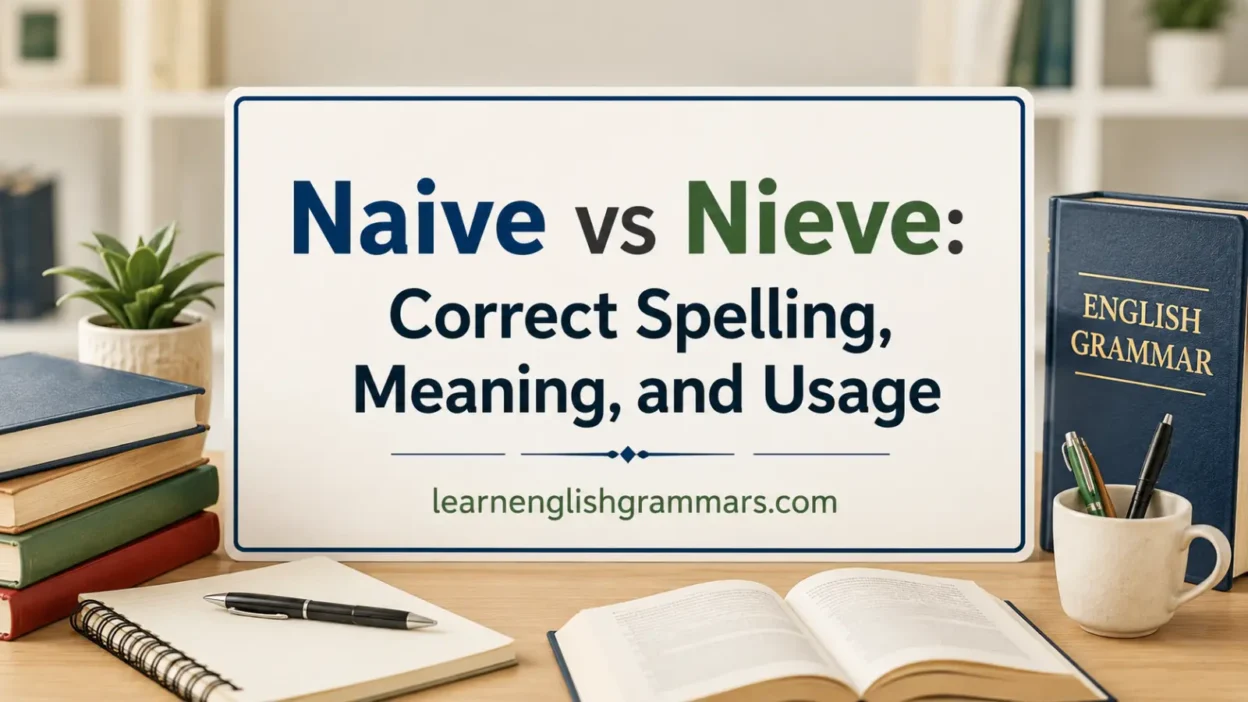
The choice between naive and nieve is simple once you know what each form does in English. Use naive when you mean innocent, inexperienced, too trusting, or lacking real-world judgment. Do not use nieve for that meaning in standard US English.
This confusion usually happens because naive does not look the way it sounds. Many people hear “ny-EEV” and guess the spelling as nieve. That guess is understandable, but it is still wrong for a person, idea, decision, or belief that shows a lack of experience.
Quick Answer
Naive is the correct spelling in standard US English. It means innocent, inexperienced, or too ready to believe something. Nieve is not the correct spelling for that meaning. In most school, work, and everyday writing, nieve will look like a misspelling. You can also write naïve with the two dots over the i, but naive is more common in plain modern writing.
Why People Confuse Them
People confuse naive and nieve because the sound does not clearly show the spelling. The word naive is usually pronounced “ny-EEV.” Since the long “ee” sound often appears as ie in English words, some writers choose nieve by mistake.
Another reason is the accented spelling naïve. The two dots over the i can look unfamiliar. When writers remove the mark, they sometimes rearrange the letters and create nieve instead of naive.
There is also a language mix-up. Nieve is a Spanish word for snow and can appear as a rare English dialect noun. Those meanings do not make it correct for naive in modern US English.
Key Differences At A Glance
| Context | Best Choice | Why |
|---|---|---|
| Describing an inexperienced person | naive | This is the standard adjective. |
| Describing a trusting belief | naive | It means too innocent or too trusting. |
| School or business writing | naive | It is the accepted spelling. |
| Casual texting | naive | Even informal writing should use the correct form. |
| Trying to spell the word by sound | not nieve | Nieve is a common spelling mistake for this meaning. |
| Referring to a rare dialect word for hand or fist | nieve | This is a separate, uncommon noun meaning. |
Meaning and Usage Difference
Naive is an adjective. It describes someone or something that shows innocence, lack of experience, or too much trust. A person can be naive. A plan can be naive. A question, belief, or expectation can also be naive.
Examples:
A new investor may be naive about online scams.
It was naive to assume every review was honest.
Her first business plan was creative but naive.
The word can sound gentle or critical. If you say a child is naive, you may mean innocent. If you say an adult made a naive decision, you may mean the person should have known better.
Nieve does not carry that meaning in standard US English. When readers see nieve in a sentence like “He was nieve,” they will usually read it as an error. It does not work as the normal adjective for innocent, inexperienced, or overly trusting.
Tone, Context, and Formality
Naive is acceptable in everyday, academic, and professional writing, but tone matters. It can sound negative because it suggests poor judgment. In careful writing, naive should describe the idea or action, not insult the person.
Better: The estimate was naive because it ignored shipping costs.
Harsher: You are naive.
In professional writing, specific wording is often safer. Instead of calling a coworker naive, you might write inexperienced, overly optimistic, or not fully informed.
Nieve is not a formal alternative. It does not sound polished, softer, or advanced. For the intended meaning, it looks incorrect.
The spelling naïve is also correct, but it has a more traditional look. Many US readers recognize it, yet plain naive is easier to type and widely accepted.
Which One Should You Use?
Use naive when you mean someone lacks experience or trusts too easily. This is the cleanest choice for US readers.
Use naïve only if your style allows accented characters. It has the same meaning as naive.
Do not use nieve for this meaning. It may confuse readers, distract from your sentence, or make polished writing look careless.
Here is a compact comparison:
- Naive: correct standard spelling for the adjective.
- Naïve: also correct, with a traditional accent mark.
- Nieve: not correct for the meaning “inexperienced” or “too trusting.”
When One Choice Sounds Wrong
Naive sounds wrong when it is used to attack someone instead of describe a specific lack of experience. The word can be fair, but it can also feel dismissive.
Too blunt: Only a naive person would believe that.
Better: That belief seems naive because it ignores the risk.
Nieve sounds wrong whenever it replaces naive in standard English.
Incorrect: She was nieve about the cost of college.
Correct: She was naive about the cost of college.
Incorrect: The plan sounds nieve.
Correct: The plan sounds naive.
If your spell-checker does not flag nieve, do not assume it is correct. It may be recognizing another word, not your intended meaning.
Common Mistakes (and Quick Fixes)
The most common mistake is spelling the adjective as nieve because the word sounds like it should contain ie. The fix is simple: write naive.
Mistake: He made a nieve choice.
Fix: He made a naive choice.
Another mistake is thinking naive always means stupid. It does not. A smart person can be naive in a new situation. The word points to limited experience, not low intelligence.
Mistake: Naive means dumb.
Fix: Naive means inexperienced, innocent, or too trusting.
A third mistake is using naive too broadly. Not every bad decision is naive. The word fits when the problem comes from inexperience or unrealistic trust.
Mistake: The late report was naive.
Better: The late report was careless.
Everyday Examples
She was naive to believe the deal had no hidden fees.
The email looked official, so a naive user might click the link.
His answer was honest but a little naive.
The startup had a naive plan for entering a crowded market.
I was naive about how much work the move would take.
It is naive to think every online seller is trustworthy.
The teacher explained the mistake without making the student feel naive.
Her early views were naive, but she learned quickly.
The team’s timeline was naive because it ignored testing.
Do not write nieve when you mean naive.
Dictionary-Style Word Details
Verb
Naive: Not commonly used as a verb in standard US English. You would not normally say “to naive someone.”
Nieve: Not used as a verb for the meaning “make someone inexperienced” or “act too trusting.” Avoid it as a verb in this comparison.
Noun
Naive: The word naive is mainly an adjective. For a noun, use naivety or naiveté. Example: His naivety made him easy to mislead.
Nieve: In rare dialect use, nieve can be a noun meaning a hand or fist. That meaning is separate from naive and is not the word most US readers expect.
Synonyms
Naive: Closest plain alternatives include inexperienced, innocent, unsophisticated, trusting, and overly trusting. Use gullible only when someone is easily fooled.
Nieve: No useful synonym applies when nieve is used as a misspelling of naive. For its rare dialect noun meaning, alternatives include hand or fist.
Antonyms for naive include experienced, worldly, skeptical, informed, or sophisticated, depending on the sentence.
Example Sentences
Naive: It was naive to believe the offer had no conditions.
Naive: The policy sounded good, but the details were naive.
Naive: I was naive when I started my first job.
Nieve: Do not write “She was nieve” when you mean “She was naive.”
Nieve: In modern US writing, most readers will treat nieve as a spelling error in this context.
Word History
Naive entered English through French and kept a spelling that can look unusual. The accented form naïve shows that the a and i are pronounced separately.
Nieve has a different background when used as a rare dialect noun. That history does not make it a valid spelling of naive in ordinary US English.
Phrases Containing
Naive: naive person, naive belief, naive question, naive assumption, naive view, naive mistake, politically naive, financially naive.
Nieve: No common modern US phrases use nieve to mean innocent or inexperienced. If you are trying to write one of the phrases above, use naive.
FAQs
Is Nieve A Correct Spelling Of Naive?
No. Nieve is not correct when you mean innocent, inexperienced, or too trusting. The correct spelling is naive. The accented spelling naïve is also acceptable, but avoid nieve in standard US English.
Is Naïve Better Than Naive?
Naïve is not better; it is another accepted spelling. The two dots over the i show that the vowels are pronounced separately. In everyday US writing, naive without the mark is clear, correct, and easier to type.
Is Nieve A Real Word?
Yes, but not usually in the way people intend here. Nieve can appear as a rare dialect noun meaning hand or fist, and it is also a Spanish word for snow. Those meanings do not make it the right spelling for naive.
Does Naive Mean Dumb?
No. Naive does not mean dumb. It means lacking experience, being innocent, or trusting too easily. A person can be intelligent and still be naive about a specific topic, such as contracts, scams, dating, travel, or workplace politics.
Can I Use Naive In Formal Writing?
Yes. Naive is acceptable in formal writing, but use it carefully. It can sound judgmental if aimed directly at a person. In reports, essays, and professional messages, it is often better to describe the exact problem, such as an unrealistic assumption or limited experience.
What Is The Noun Form Of Naive?
The common noun forms are naivety and naiveté. Both refer to the quality or state of being naive. Example: Her naivety made her believe the offer was risk-free. Naive itself is mostly used as an adjective.
Conclusion
Naive vs nieve is not a choice between two equal English adjectives. Naive is the correct standard spelling when you mean innocent, inexperienced, or too trusting. Naïve is also correct, but it is less convenient to type.
Nieve should not be used for that meaning in standard US English. It may exist in other limited contexts, but it will usually look like a spelling mistake when you write about a naive person, belief, plan, or decision. For clear writing, choose naive.