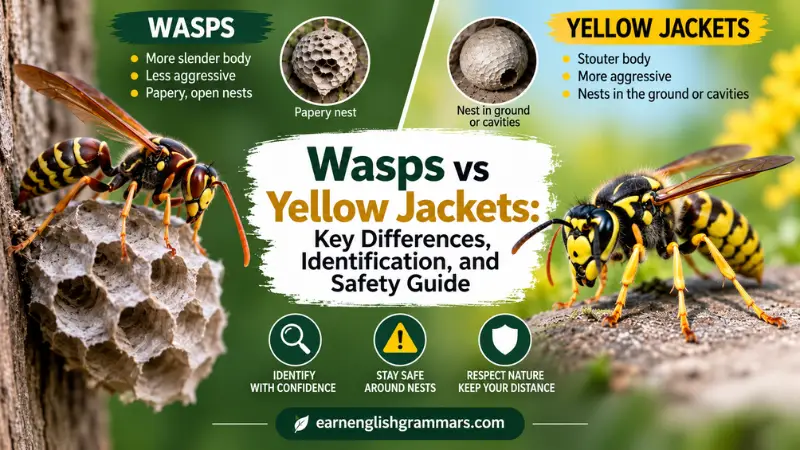
Wasps vs yellow jackets is a common comparison because many people use these names interchangeably, but they do not describe exactly the same thing. A yellow jacket is actually a type of wasp, while the word wasp refers to a much larger group of insects with many different species.
The main difference is that yellow jackets are usually more aggressive, social wasps that build large colonies and often defend their nests aggressively. Other wasps may be solitary or less defensive. Knowing the difference helps with identification, outdoor safety, and understanding which insects are actually around your home.
This guide explains how wasps and yellow jackets differ in appearance, behavior, nests, stings, habitats, and common misconceptions.
Quick Answer
Yellow jackets are a type of wasp, but not all wasps are yellow jackets. Wasps include thousands of species, while yellow jackets are specific social wasps known for their black-and-yellow markings, underground nests, and defensive behavior. Most wasps help control pests, but yellow jackets are more likely to become aggressive when they feel their colony is threatened.
TL;DR
- Yellow jackets are wasps, but they are only one group within the larger wasp family.
- Wasps can have many colors, body shapes, and behaviors.
- Yellow jackets usually have bright yellow-and-black patterns and live in colonies.
- Many wasps are beneficial because they eat garden pests.
- Yellow jackets are more likely to sting repeatedly and defend their nests.
- Avoid disturbing any nest, especially one located near homes or outdoor areas.
Wasps vs Yellow Jackets: Main Difference
| Feature | Wasps | Yellow Jackets |
|---|---|---|
| Classification | Broad group of insects | A specific type of wasp |
| Appearance | Many colors and body shapes | Usually black and yellow |
| Body shape | Often slender with narrow waists | Compact body with less visible waist |
| Social behavior | Can be solitary or social | Mostly social colony insects |
| Nest location | Trees, walls, soil, buildings, plants | Often underground or hidden cavities |
| Behavior | Depends on species | Often defensive near nests |
| Sting ability | Many can sting multiple times | Can sting repeatedly |
| Common examples | Paper wasps, mud daubers, hornets | Ground-nesting yellow jackets |
What Is a Wasp?
A wasp is a broad term for insects in the order Hymenoptera, which also includes ants and bees. Wasps come in many forms, ranging from tiny parasitic species to large predators.
Some common types of wasps include:
- Paper wasps
- Mud daubers
- Potter wasps
- Hornets
- Yellow jackets
Wasps can be solitary or social. Solitary wasps usually live alone and rarely bother humans. Social wasps create colonies with queens and workers that cooperate to build nests and raise young.
Many wasps are considered beneficial insects because they help control populations of spiders, caterpillars, flies, and other pests.
Example
A gardener may see a paper wasp flying around flowers and assume it is dangerous. However, many paper wasps ignore people unless their nest is disturbed.
What Is a Yellow Jacket?
A yellow jacket is a type of social wasp known for its yellow-and-black coloring and defensive nature.
In the United States, yellow jackets commonly belong to the genera Vespula and Dolichovespula. They often build nests underground, inside wall spaces, or in protected areas.
Yellow jackets are different from many other wasps because they:
- Live in large colonies
- Protect their nests aggressively
- Search for sugary foods and proteins
- Frequently appear around trash cans, picnics, and outdoor meals
Unlike bees, yellow jackets can sting multiple times because they do not lose their stinger after attacking.
Why Are Yellow Jackets More Aggressive Than Many Wasps?
Yellow jackets are often considered more aggressive because they strongly defend their colonies.
Their behavior becomes especially noticeable in late summer and early fall when:
- Their colonies are larger
- Natural food sources become limited
- Workers search more actively for food
A yellow jacket may investigate human food, drinks, or garbage because it is attracted to sugars and proteins.
However, yellow jackets usually do not attack randomly. Most stings happen when:
- Someone steps near an underground nest
- A nest is disturbed
- A person tries to swat them repeatedly
Appearance Differences Between Wasps and Yellow Jackets
Wasp Appearance
Wasps can look very different depending on the species. They may have:
- Long, narrow bodies
- Bright colors
- Red, brown, black, or metallic patterns
- Long legs
- Slim waists
For example, paper wasps often have long legs that hang downward while flying.
Yellow Jacket Appearance
Yellow jackets usually have:
- Black-and-yellow bands
- Shorter, thicker bodies
- Smooth appearance
- Compact shape
They are often mistaken for bees because of their coloring, but yellow jackets have a slimmer waist and smoother body.
Nest Differences
Wasp Nests
Wasp nests vary widely.
Common locations include:
- Tree branches
- Eaves of buildings
- Attics
- Under outdoor structures
- Plants and shrubs
Paper wasps create open, umbrella-shaped nests with visible honeycomb-like cells.
Mud daubers build small mud tubes rather than large colonies.
Yellow Jacket Nests
Yellow jackets often build enclosed nests.
Common nest locations include:
- Underground holes
- Wall spaces
- Attics
- Hollow trees
- Abandoned animal burrows
Their nests may contain thousands of insects, making them more difficult and dangerous to remove.
Are Wasps More Dangerous Than Yellow Jackets?
In most cases, yellow jackets are more likely to create problems for people than many other wasps, but the danger depends on the species and situation.
A wasp sting may cause:
- Pain
- Redness
- Swelling
- Itching
A yellow jacket sting may be more concerning because:
- They can sting repeatedly
- They may attack in groups
- They often defend hidden nests
However, any wasp or yellow jacket can be dangerous to someone with a severe allergy.
Seek emergency medical help if a sting causes symptoms such as:
- Difficulty breathing
- Swelling of the face or throat
- Dizziness
- Rapid heartbeat
- Severe allergic reaction
Wasps vs Yellow Jackets: Which One Is More Helpful?
Both wasps and yellow jackets play important roles in ecosystems.
Benefits of Wasps
Many wasps help by:
- Eating garden pests
- Pollinating some plants
- Supporting natural insect control
Farmers and gardeners often benefit from certain wasp species because they reduce harmful insect populations.
Benefits of Yellow Jackets
Yellow jackets also contribute by:
- Hunting insects
- Removing dead animals and organic material
- Supporting food chains
Although they can become a nuisance around humans, they are still part of a healthy ecosystem.
Common Confusion: Are Yellow Jackets Bees?
No. Yellow jackets are not bees.
The confusion happens because both insects may have yellow-and-black coloring.
Key differences:
| Feature | Yellow Jacket | Bee |
|---|---|---|
| Body | Smooth and shiny | Hairier |
| Sting | Can sting repeatedly | Usually stings once |
| Food | Insects, meat, sweets | Mainly nectar and pollen |
| Behavior | More defensive | Usually less aggressive |
| Body shape | Narrow waist | Rounder body |
Common Confusion: Are Hornets and Yellow Jackets the Same?
The answer depends on location and classification.
In the United States, some insects called “hornets” are actually yellow jackets. The names are often used differently in everyday speech.
For example:
- Bald-faced hornets are actually a type of social wasp.
- European hornets belong to a different group.
- Yellow jackets belong to the wasp family but are not all called hornets.
Scientific classification is more reliable than common names.
How to Identify a Yellow Jacket Near Your Home
Look for these signs:
- Black-and-yellow body markings
- Fast, direct flight
- Interest in food and drinks
- Multiple insects entering the same hole
- A nest hidden underground or inside a structure
If you see several insects repeatedly entering one location, there may be a colony nearby.
How to Avoid Wasp and Yellow Jacket Stings
To reduce the chance of being stung:
- Avoid disturbing nests.
- Keep outdoor food covered.
- Seal garbage containers tightly.
- Wear shoes outdoors.
- Avoid strong movements when an insect approaches.
- Do not spray nests without knowing the species and risks.
If a nest is close to a home, playground, or high-traffic area, professional removal may be safer.
Common Myths About Wasps and Yellow Jackets
Myth 1: All Wasps Are Aggressive
False. Many wasps avoid humans and only defend themselves or their nests.
Myth 2: Yellow Jackets Are Always Looking for People to Attack
False. They usually sting when threatened or when protecting their colony.
Myth 3: Killing Every Wasp Is Helpful
False. Many wasps provide natural pest control and benefit gardens.
Myth 4: Yellow Jackets Are Just Angry Bees
False. Yellow jackets are wasps, not bees.
FAQs
Are yellow jackets worse than wasps?
Yellow jackets are often more troublesome because they are social insects that defend large colonies and may sting repeatedly. However, the risk depends on the species and situation.
Do all wasps sting?
No. Many wasps can sting, but some species rarely interact with humans. Male wasps also cannot sting because they lack the necessary structures.
How can you tell a wasp from a yellow jacket?
A yellow jacket usually has clear black-and-yellow bands and a compact body. Other wasps may have different colors, shapes, and behaviors.
Do yellow jackets die after they sting?
No. Unlike honey bees, yellow jackets can sting multiple times because their stingers are smooth and do not remain stuck in the victim.
Are wasps good for gardens?
Yes. Many wasps help gardens by eating insects that damage plants, including caterpillars and other pests.
Should I remove a yellow jacket nest myself?
Removing a yellow jacket nest can be risky, especially if it is large or located near people. Professional removal may be the safest option.
Conclusion
The main difference in wasps vs yellow jackets is that yellow jackets are a specific type of wasp, not a separate insect group. Wasps include many species with different appearances and behaviors, while yellow jackets are known for their black-and-yellow coloring, colonies, and defensive nature.
Most wasps provide valuable ecological benefits by controlling pests. However, yellow jackets deserve extra caution because they can aggressively protect their nests. Learning how to identify these insects helps you respond safely and understand their role in nature.