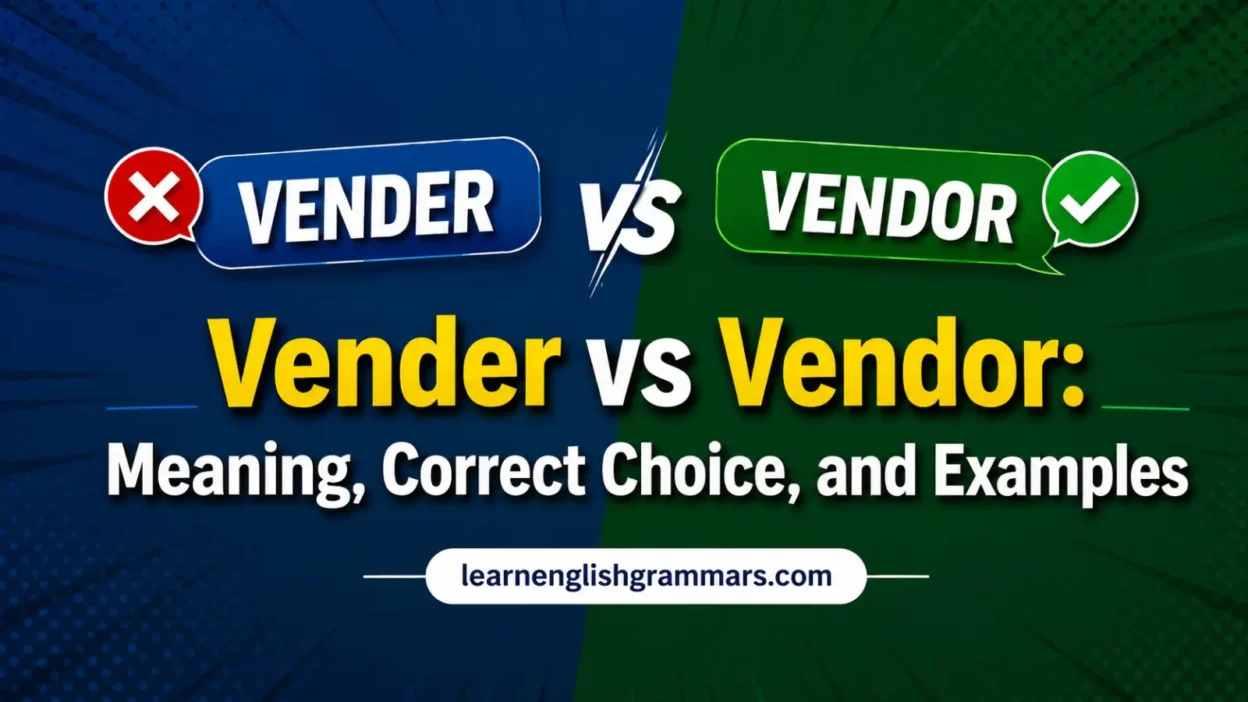
The choice between vender vs vendor can confuse writers because both forms look possible. They also sound the same in everyday speech. Still, one word is clearly the better choice for modern US English.
In most writing, use vendor. It is the standard word for a person, company, or business that sells goods or services. Vender appears in some dictionaries as a less common variant, but it is rare in polished business, legal, school, and workplace writing. Because readers expect vendor, that spelling is almost always the safer option.
Quick Answer
Vendor is the correct choice for modern US English in nearly every situation. A vendor is a seller, such as a food vendor, software vendor, street vendor, or approved business vendor. Vender is a much less common variant spelling. Although some dictionaries list it, most writers should avoid it in professional writing.
Why People Confuse Them
People confuse vender and vendor because both come from the idea of selling. The verb vend means to sell, especially in a public or commercial setting. Since English often forms nouns with -er, the spelling vender may look natural.
However, English does not always follow the simplest pattern. The standard noun became vendor, not vender, in common modern use. That is why seller uses -er, but vendor uses -or.
The words also sound alike. In normal American pronunciation, both would be said like “VEN-der.” Since the sound does not clearly show the spelling, writers may choose the wrong form by ear.
Key Differences At A Glance
| Context | Best Choice | Why |
|---|---|---|
| Business contract | vendor | Standard professional spelling |
| School essay | vendor | Clear and expected |
| Food cart or street seller | vendor | Common phrase: street vendor |
| Software company | vendor | Common phrase: software vendor |
| Purchase order | vendor | Standard business term |
| Casual note | vendor | Still the safest spelling |
| Older or variant spelling discussion | vender | Only when discussing the variant itself |
Meaning and Usage Difference
Vendor means a person, company, or organization that sells something. The item may be food, software, equipment, services, clothing, event supplies, or almost any product.
Examples include:
A hot dog vendor sold lunch outside the stadium.
The company changed its payroll vendor.
We need three vendor quotes before approving the project.
Vender means the same thing when it appears as a noun, but it is not the form most readers expect. In modern US writing, vender can look like a typo even when a dictionary records it as a variant.
So the real difference is not meaning. The difference is standard use. Vendor is the normal spelling. Vender is uncommon and usually not the best choice.
A simple way to remember it: use vendor when you mean a seller.
Tone, Context, and Formality
Vendor works in casual, formal, business, and legal contexts. It sounds natural in everyday writing and professional documents.
You can use it in phrases like:
approved vendor
food vendor
software vendor
event vendor
third-party vendor
vendor contract
vendor invoice
Vender does not usually add a special tone. It does not make a sentence more formal, more American, or more precise. Instead, it may distract readers because they may wonder whether it is a mistake.
In a text message, vender might be understood. In a resume, invoice, contract, school paper, or website article, vendor is the stronger choice.
Pronunciation does not create a useful difference here. In practical US speech, the two forms are pronounced the same way: VEN-der.
Which One Should You Use?
Use vendor almost every time.
Choose vendor when writing about a seller, supplier, company, contractor, or service provider. It is the spelling readers expect in modern US English.
Use vender only if you are quoting an older source, discussing spelling variants, or referring to a title or name that officially uses that spelling.
Here is the safest rule:
Vendor is the standard spelling. Vender is a rare variant. When in doubt, write vendor.
This rule works for business emails, schoolwork, articles, contracts, invoices, event planning, software buying, restaurant supply orders, and marketplace writing.
When One Choice Sounds Wrong
Vender sounds wrong when the context is professional or business-related.
Awkward: We selected a new vender for office supplies.
Better: We selected a new vendor for office supplies.
Awkward: Please send the vender invoice by Friday.
Better: Please send the vendor invoice by Friday.
Awkward: The software vender offers 24-hour support.
Better: The software vendor offers 24-hour support.
The spelling vendor also fits common business systems. Companies usually talk about vendor accounts, vendor payments, vendor onboarding, vendor management, and vendor approval. In those phrases, vender looks out of place.
Common Mistakes (and Quick Fixes)
One common mistake is using vender because it looks like seller. The fix is simple: remember that the standard noun is vendor.
Mistake: The vender delivered the chairs.
Fix: The vendor delivered the chairs.
Another mistake is using vendor when seller would sound more natural. Vendor is common in business and organized selling. Seller is broader and more everyday.
Natural: The seller accepted our offer on the house.
Also possible: The vendor accepted our offer.
Better for everyday US real estate writing: The seller accepted our offer.
A third mistake is confusing vendor with supplier. A supplier provides goods or materials, often to another business. A vendor sells goods or services. Sometimes one company can be both, but the words are not always identical.
Everyday Examples
Vendor: We hired a local vendor for the wedding flowers.
Vendor: The school uses a lunch vendor for daily meals.
Vendor: Our company needs a new cloud storage vendor.
Vendor: The festival had food vendors on both sides of the street.
Vendor: Please upload the vendor contract before the meeting.
Vendor: The vendor sent a revised estimate this morning.
Vendor: She runs a small vendor booth at weekend markets.
Vendor: The office manager keeps a list of approved vendors.
Vender: The spelling vender may appear as a variant in some references.
Vender: Use vender only when you have a specific reason to preserve that spelling.
Dictionary-Style Word Details
Verb
Vender: Not commonly used as a verb in standard US English. Use vend if you need the verb meaning “to sell.”
Example: The company vends snacks through machines.
Vendor: Usually a noun. In some technical contexts, vendor can appear as a verb meaning to include or supply through a vendor-like process, but most everyday writers do not need this use.
For clear general writing, use sell, supply, provide, or vend instead of forcing either word as a verb.
Noun
Vender: A less common noun variant meaning a seller. It is understandable, but it is not the normal spelling in current professional writing.
Vendor: A standard noun meaning a person, company, or organization that sells goods or services.
Examples:
The vendor shipped the replacement part.
A street vendor sold tacos near the park.
The company reviewed three vendors before signing the contract.
Synonyms
Vender: Closest plain alternatives are seller, merchant, dealer, and trader. Since vender is rare, vendor is usually the better replacement.
Vendor: Useful synonyms include seller, supplier, merchant, dealer, retailer, and provider. These are not always exact matches.
Seller is the broadest plain alternative.
Supplier often fits business supply chains.
Provider works well for services.
Retailer means a business that sells directly to customers.
Clear antonyms include buyer, customer, and purchaser, depending on the sentence.
Example Sentences
Vender: The editor changed vender to vendor for consistency.
Vender: Some dictionaries list vender, but most business writers use vendor.
Vendor: The vendor will deliver the tables at noon.
Vendor: We compared prices from three software vendors.
Vendor: The city requires each food vendor to have a permit.
Vendor: Please send the vendor payment confirmation today.
Word History
Vender: This form is connected to the verb vend, meaning to sell. Its spelling looks regular because many English nouns use -er for a person who performs an action. Still, it did not become the preferred modern spelling.
Vendor: This form is the established spelling in modern English for a seller. It is related to the same selling idea, but the -or ending is the standard form readers expect today.
The exact history can become technical, so the practical point matters most: both forms relate to selling, but vendor is the current standard choice.
Phrases Containing
Vender: No common modern US phrases strongly require vender. It may appear only as a variant spelling.
Vendor: Common phrases include:
approved vendor
preferred vendor
street vendor
food vendor
software vendor
vendor contract
vendor invoice
vendor payment
vendor management
third-party vendor
vendor booth
vendor list
vendor account
These phrases show why vendor is the safer spelling. It appears naturally in business, events, food service, software, purchasing, and finance.
FAQs
Is vender or vendor correct?
Vendor is the correct and preferred choice in modern US English. Vender is listed by some references as a less common variant, but it is rare. For clear writing, use vendor.
Is vender a misspelling?
Not always. Some dictionaries record vender as a variant of vendor. However, many readers may still see it as a mistake because vendor is far more common and expected.
What does vendor mean?
A vendor is a person, business, or organization that sells goods or services. A food vendor sells food, a software vendor sells software, and an event vendor provides services for an event.
Should I use vender in business writing?
No. Use vendor in business writing. It looks professional and matches common phrases like vendor invoice, vendor contract, vendor payment, and approved vendor.
Is vendor the same as seller?
Sometimes, but not always. Seller is a broad everyday word. Vendor often sounds more businesslike or organized, especially when talking about companies, services, events, contracts, or supply systems.
What is the easiest way to remember vendor?
Think of common business phrases: vendor list, vendor invoice, vendor contract, and software vendor. All use vendor with -or, not vender with -er.
Conclusion
For vender vs vendor, the best choice is vendor. It is the standard modern spelling for a person, company, or organization that sells goods or services.
Vender may appear as a less common variant, but it is rarely the right choice for polished US writing. In business emails, school papers, contracts, articles, invoices, and everyday examples, vendor is clearer, more natural, and more professional.
When you need the noun, write vendor. When you need the verb, use vend or sell.